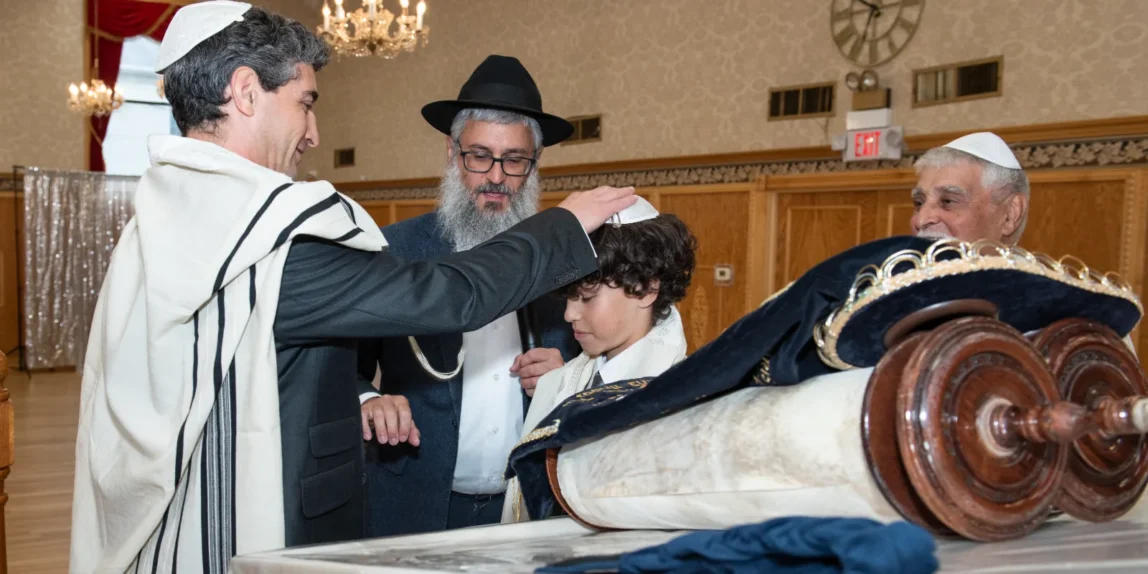
The morning usually starts early. A suit or dress gets steamed, a grandparent’s flight lands the night before, and a thirteen-year-old who was mostly worried about homework a few months ago is suddenly standing at the center of a synagogue sanctuary. By evening there may be music, a reception hall, and a dance floor full of cousins. It is easy to see the day as one long celebration. It is worth remembering that it is also something older: a moment in a tradition that families have marked, in different ways, for a very long time. Understanding where the Bar Mitzvah came from helps explain why so many families in North New Jersey and Bergen County choose to document the day carefully, not just as a party, but as a chapter in their own family history.
What Does “Bar Mitzvah” Actually Mean?
The phrase itself is straightforward once it’s broken down. “Bar” is Aramaic for “son,” and “mitzvah” is Hebrew for “commandment.” Put together, “Bar Mitzvah” describes someone who has become obligated to observe Jewish commandments — not a party, and originally not even a ceremony, but a change in religious status.
In traditional Jewish practice, a boy reaches this status at age thirteen. A girl reaches the equivalent status, known as Bat Mitzvah, at age twelve in many communities, though this varies. From that point on, the young person is considered accountable for their own religious obligations rather than relying on a parent to fulfill them on their behalf.
How that status is marked differs by community. Orthodox, Conservative, Reform, and Reconstructionist congregations each approach the ceremony a little differently, particularly when it comes to a girl’s role in reading from the Torah or leading prayers. None of these approaches is more “authentic” than another — they reflect how different communities have interpreted the same underlying tradition.
How Old Is the Bar Mitzvah Tradition, Really?
It’s tempting to assume that today’s Bar Mitzvah, with its Torah portion and evening reception, has looked essentially the same for thousands of years. Historians of Jewish custom generally caution against that idea.
The underlying religious concept — that a young person becomes responsible for the commandments at a certain age — is genuinely ancient. One of the earliest known references appears in the Mishnah, a foundational compilation of Jewish law and teaching completed around the third century CE, which lists age thirteen among a series of life stages, including responsibility for the commandments. That is a statement about religious obligation, though, not a description of a synagogue ceremony.
The specific, recognizable custom of publicly calling a thirteen-year-old boy to read from the Torah as a marker of this transition appears to have developed considerably later. Scholars generally place the emergence of a distinct Bar Mitzvah ceremony in medieval Europe, with the practice becoming more established among Ashkenazi Jewish communities by roughly the fourteenth and fifteenth centuries. Exact origins are debated, and the historical record from that period is incomplete, so it’s more accurate to say the ceremony evolved gradually rather than appeared at a single moment.
How the Ceremony Developed
Over time, several elements became closely associated with the occasion: being called up for an aliyah (the honor of reciting blessings before and after a Torah reading), reading or chanting a portion of the Torah or the accompanying prophetic reading, and a rabbi or family member offering words of blessing or instruction to the young person.
A festive meal, known in Hebrew as a seudat mitzvah, often followed the synagogue service. This tradition of marking a religious milestone with a shared meal has older roots than the elaborate modern reception, but it establishes an important point: celebrating together after a religious rite of passage is not a recent invention. What has changed is the scale.
Bat Mitzvah ceremonies, by contrast, are a much more recent development. The first documented Bat Mitzvah in the United States is widely credited to Judith Kaplan, daughter of Rabbi Mordecai Kaplan, founder of the Reconstructionist movement, who marked the occasion in New York in 1922. Since then, Bat Mitzvah practices have continued to evolve differently across denominations.
From Religious Milestone to Family Celebration
The large-scale reception many families associate with a Bar or Bat Mitzvah today — a hired venue, a DJ or band, a seated dinner, extended-family dancing — is a largely twentieth-century American development. As Jewish communities grew and prospered in the decades following World War II, families increasingly extended the traditional seudat mitzvah into a more elaborate celebration, shaped by the same broader American culture of weddings and milestone parties.
That evolution has continued in communities like ours across North New Jersey and Bergen County, where families celebrate in settings ranging from an intimate synagogue kiddush to a large evening reception. Neither approach is more meaningful than the other. The religious milestone at the center of the day — a young person accepting responsibility within their tradition — is the same regardless of the size of the party that follows.
A Meeting of Generations
Perhaps the most quietly significant part of a Bar or Bat Mitzvah is who is in the room. Parents, siblings, grandparents, and sometimes great-grandparents gather alongside cousins and longtime family friends, often traveling considerable distances to be there.
These gatherings don’t happen often. A photograph of a thirteen-year-old standing next to a grandparent may not seem especially significant on the day it’s taken — it’s one image among many. Years later, it can become one of the only photographs that exists of the two of them together. Families rarely know in the moment which photograph from the day will matter most later on.
Photographing the Occasion: Why Formal Portraits Still Matter
Families today generally have far more photographs of their milestone occasions than previous generations did. Where a grandparent’s own Bar Mitzvah might be documented by a handful of black-and-white prints, a modern celebration can generate thousands of images — from smartphones, guests, and a hired photographer alike.
Smartphones are genuinely good at capturing spontaneous, candid moments: a laugh during a speech, a hug on the dance floor. Intentional, planned portraits serve a different purpose. Without setting aside time for them, it’s common for a family to end an event with hundreds of candid photos but not one clear portrait containing every important person in the same frame. A working list, planned in advance, helps avoid that gap.
A Practical Portrait Checklist
| Grouping | Why It’s Worth Planning For |
|---|---|
| The Bar/Bat Mitzvah with both parents | Often the single most requested portrait later on |
| Child with each set of grandparents | May become a rare or irreplaceable image over time |
| Full sibling group | Sibling dynamics change quickly with age |
| Multi-generational family portrait | Not every relative attends every future occasion |
| Synagogue and Torah-reading moments | Documents the religious context, not just the party |
| Candid reception and dancing shots | Captures personality and atmosphere alongside formal images |
Frequently Asked Questions
What is the traditional age for a Bar Mitzvah or Bat Mitzvah?
Traditionally, a boy becomes Bar Mitzvah at thirteen. A girl becomes Bat Mitzvah at twelve in many communities, though the age and ceremony vary by denomination.
Is the modern Bar Mitzvah party thousands of years old?
No. The religious concept of becoming responsible for the commandments is ancient, but the recognizable synagogue ceremony developed in medieval Europe, and today’s large receptions are largely a twentieth-century American development.
What’s the difference between a Bar Mitzvah and a Bat Mitzvah?
A Bar Mitzvah marks the milestone for a boy; a Bat Mitzvah marks the equivalent milestone for a girl. Bat Mitzvah ceremonies are a more recent tradition, first documented in the United States in 1922, and practices still vary between denominations.
Do we need a large party for the occasion to be meaningful?
No. The religious milestone is the same whether it’s marked with an intimate synagogue gathering or a large evening reception. Families across North New Jersey and Bergen County celebrate in both styles, and neither is more significant than the other.